
Coping with Anxiety
When You Can't Stop the Trigger

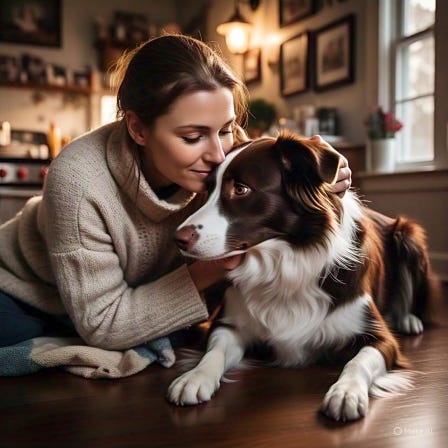
Last week, I introduced some animal behaviors as a parallel to understanding autistic self-soothing behaviors. We often misread behavior, and when it comes to animals, we just find it funny.
I want to bring awareness to the behavior so that we can offer support or maybe encourage reflection.
My border collie is sensitive to sounds, and she experiences anxiety with specific sounds like gun shots (from hunters), thunder, and falling ice. These are all things that I have no control over. I cannot prevent these triggers. The best I can do is help her cope with her anxiety.
A few weeks ago, we had an ice storm. Freezing rain followed by a rise in temperature caused the ice to crash to the ground off trees and rooftops.
What are some signs of anxiety in a dog?
Hiding
Rigid, stiff body
Skin flinches to the touch
Tucked tail, but this is not always an indication on its own
I found my girl in the kitchen, but not in her usual spot. That’s another indication that something is off when there’s a behavior change.
When I touched her, I could feel that her muscles were tight, and her skin twitched to my touch. I could also see the stress in her eyes.
Instead of making her come somewhere more comfortable for me, I got a blanket and pillow and got down on the floor near her, but still away from her. After all, she had chosen that spot because that’s where she felt safest.
Just because I could see she was tense, I didn’t force myself into her space.
As humans, when we’re uncomfortable with how someone else is feeling, we try to influence them, and we tell ourselves it’s because we want them to feel better. In reality, our motivation is to make ourselves feel better.
Once I was on the floor, she came and sat down beside me, with her back and weight against me. This is a sign of trust and an invitation to touch her.
I petted her to help her relax her body.
There’s a pattern when a dog is releasing anxiety that some people may be uncomfortable witnessing and judge it as further signs of anxiety. I share this information so that you know what to watch for as positive indications that their nervous system is realigning.
Signs a dog is releasing anxiety
Sounds, vocalizations
Trembling
Panting
Yawning
As I petted her, I reassured her, not just with my words, that she was safe.
It’s important to be cognizant of your emotional frequency. Animals read your energy. If seeing your beloved pet tremble with fear upsets you, you need to regulate yourself before you can offer to comfort them, or you’ll just make it worse for them.
In a short time, she began emoting. Vocalizing herself. Again, this is a sign of deep trust. Dogs do not show weakness unless they feel safe. In the animal world, weakness invites attack. I encouraged her to talk, to let it out.
I continued petting her, especially around her neck, chest, and face. I wanted to stimulate her breathing and relax her muscles. She leaned into me more, and her body shook, tiny little vibrations. Then she sat up, and the heavy panting started.
Now that she was breathing, I shifted my petting to include the area at the base of her spine. I applied light pressure and made small circular movements with my palm just above her tail.
I allowed for all of it to unfold at her pace. As long as she needed me to stay present, I continued to stroke her body, or caress and kiss her face.
The final sign of recalibration is yawning. That’s the brain and nervous system resetting itself. All the tension left her body.
At this point, it’s common for a dog to take a nap. Being stressed, whether for a dog or a person, is draining.
How long can you expect the anxiety release to go on for?
That depends on how long the animal was under stress. The longer they suffered, the longer the recovery.
That goes for us humans, too… if you endured trauma for years, please be kind with yourself for taking years to recover.
🐾❤️
I’ve given a detailed description of how I helped my Collie release anxiety. What can you take from that description to apply being supportive to a person experiencing anxiety? Or perhaps how you may misread the self-soothing behavior of autistic people as a sign of tension rather than recalibration?
If you liked this post, please give me some feedback — a like at the bottom of this page or a restack — it feeds into the algorithm and helps my visibility. Comments are welcome, too.
My publication is free, but if you would like to show your support and appreciation for my work, you may make a monetary gift through the link below.
I sincerely thank you for your support!
I was delighted to be approached by Autistic Ang a couple of weeks ago, asking if I would be interested in being spotlighted for her readers.
She asked me questions that had me awake until 5 a.m., reflecting, and they gave me insights into myself, how far I have come, and the shadows that still follow me. This is an opportunity to get to know me as a person, not just as a collection of stories.
But first, my message to my readers:

Sooo good! This is the KEY to all relationships AND THE ONE MOST LACKING!
Meet them where they ARE, not where you WANT THEM TO BE!